



MILITARY RAILROADS OF THE NEW YORK METROPOLITAN AREA:
BROOKLYN ARMY TERMINAL
ARMY TRANSPORT CENTER
ARMY SUPPLY BASE
Owl's Head / Bay Ridge, Brooklyn
.
.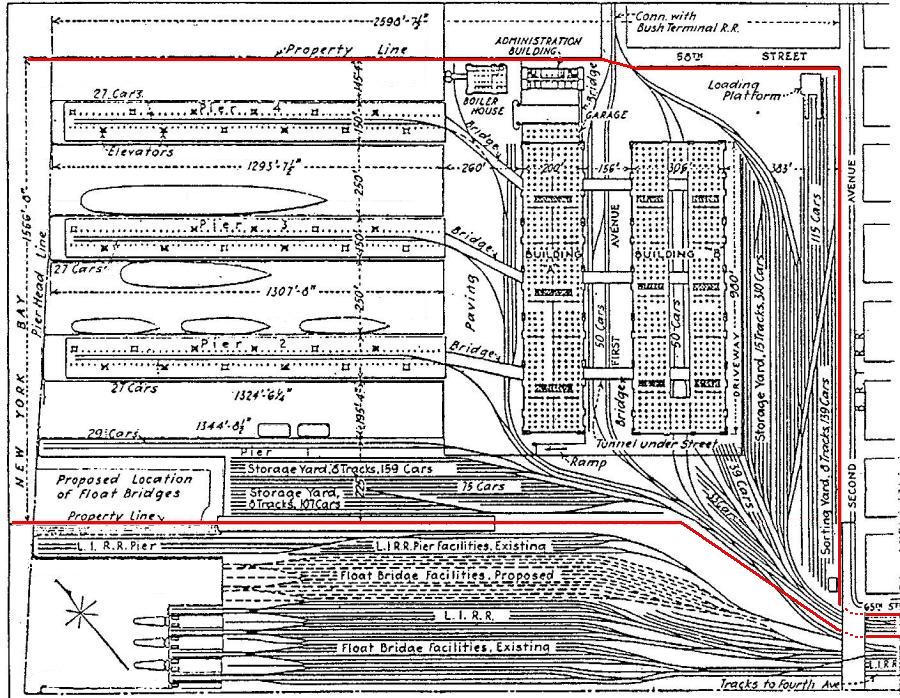
Historic American Engineering Record (HAER) #NY202
Library of Congress Digital Archives
The original providence of the map is given as Engineering News Record
1919.
BAT property annotated by author.
.
.
.


Table Of Contents:
Overview
.
The Brooklyn Army Terminal, located in the 'Owl's Head' section of Brooklyn, began construction commencing in March 1918, for the purpose of supply base and depot. Construction was completed in just 17 months, by Septemer 1919 and comprised of 5,000,000 square feet.
The design of the facility was highly innovative for its time. The complex is constructed of girder-less, steel reinforced concrete slabs and included 96 centrally-controlled push-button elevators, the largest elevator installation of its time.
Furthermore, the entire complex is interconnected, with three "skybridges" on the third floor linking the two main building structures. The larger of the two buildings featured a huge skylight-enclosed atrium equiped withn enclosed rail service, and the smaller building was joined to the atrium by three covered piers.
The Brooklyn Army Terminal (shown above bordered in red), is part of the New York Port of Embarkation, and was formerly known as the Brooklyn Army Base (1918-1959), and was also known as the New York General Depot, and Army Transport Base. It was also known as U.S. Army Military Ocean Terminal (not to be confused with Military Ocean Terminal - Bayonne), and Army Supply Base.
The Brooklyn Army Terminal remained active through the early 1970's, housing both military and civilian tenants.
The City of New York purchased the property from the federal government in 1981 with the intent of renovating the property for intended use as a light manufacturing and warehouses, with the main entrance located at 58th Street and First Avenue.
As of 1983, the Brooklyn Army Terminal has been listed on the
National Register of Historic Places in 1983. The NRHP listing includes 11
contributing buildings on an area just over of 97
acres.
There is on the internet, extensive historical documentation available on the construction techniques and uses of the Brooklyn Army Terminal. These are available from the Brooklyn Army Terminal website as well as in Library of Congress. As this website is primarily concerned with the railroad operations of the base, therefore the general nonrailroad history will not be covered here.
.
Property Acquisition & Construction
.
Mentioned in the New York Times, is that the government "requisitioned" warehouses and property from Irving Bush, (as part of Bush Terminal) on or about January 1, 1918:
"He said (Mr. Bush) that the War Department had decided that it needed a base such as the Bush Terminal furnishes and had consequently determined to take it. The facilities of the Bush Terminal will make it possible for the government to concentrate it supplies in the warehouse which are adjacent to the piers where the supply ships will be loaded."
The structures of the Brooklyn Army Terminal was designed by none other that Cass Gilbert (architect of the Woolworth building among other structures). Gilbert, is best known for his Beaux Arts and Gothic building styles, was BAT’s principal architect. Gilbert also designed the Unite States Custom House, the Broadway Chambers Building, the Essex County Courthouse and the highly-acclaimed Gothic skyscraper, the Woolworth Building.
BAT’s modern utilitarian style was markedly different from Gilbert’s previous work. Nevertheless, the structure has been recognized by modern architects the world over for its powerful aesthetic and highly functional form.
Port of Embarkation
.
During World War II; the Brooklyn Army Terminal was used as a Point of Embarkation for outgoing troops as well.
It goes without saying further, that the Brooklyn Army Terminal was most heavily trafficked during World War II, during which 56,000 military and civilian personnel were employed there. Over 3,000,000 troops and 37,000,000 tons of military supplies passed through the facility. The Brooklyn Army Terminal's service as a Port of Embarkation continued well after World War II.
Arguably the most famous soldier to deploy from BAT was Elvis
Presley. He greeted fans and a dozens of photojournalists in September of
1958 when he shipped off from Brooklyn to Germany.
The Brooklyn Army Terminal remained a Port of Embarkation through 1966.
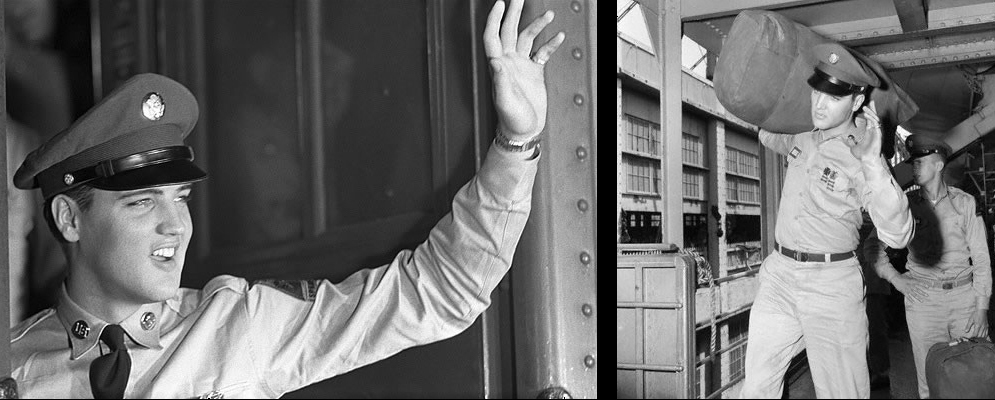
September 1958
photos by Alfred Wertheimer
.
Facilities
.
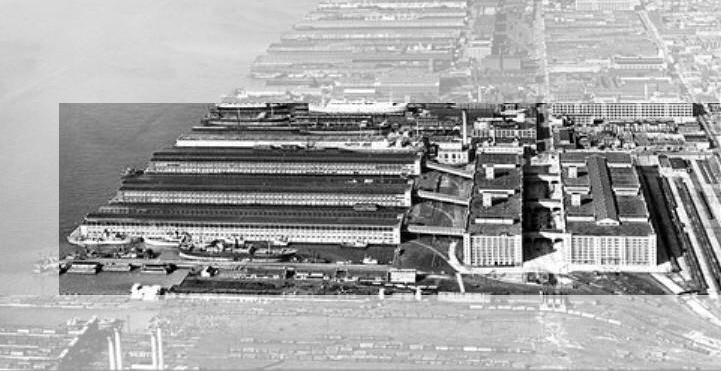
The following photo (looking north) shows the property and structure arrangement of the Brooklyn Army Terminal very well.
It should be noted the railroad yard to the right of the photo (running vertical) belongs to Brooklyn Army Terminal. However, the railroad yard at the bottom and the float bridge gantries at the bottom left corner of the photo is the 65th Street / Bay Ridge Yard of the New York, New Haven & Hartford RR / Long Island Rail Road. Bush Terminal is at the top center of the photo.
.
.
The Brooklyn Army Terminal is comprised of two huge warehouses and 3 covered multistory piers: Building 'B' (east and the wider of the two) and Building 'A' (west). Building 'A' is 980 feet x 200 feet wide and eight stories in height. Building B is 980 feet by 300 feet and eight stories high with an interior court 66 feet wide (with platforms and through tracks).
Dimensions for the ancillary buildings are as follows: heating plant, 137 feet by 88 feet with 225 foot smokestack and the administration building with a huge cafeteria and kitchen area (204 feet x 64 feet).
Building 'B' is connected to Building 'A' by three enclosed skybridges 150 feet long allowing matériel to be moved from building to building without being exposed to weather or hindering street traffic.
Building 'A' is connected by skybridges 260 feet long to the three covered "double deck" piers which are 1300 feet long by 150 feet wide. To the south of the covered piers there was also a single open pier 1300 feet by 60 feet wide, but this pier was not connected to any of the structures.
The skybridges from Building 'B' to Building 'A' and the skybridges from Building 'A' to the piers are in line with one another, and there are ninety freight elevators in banks of 6, 8 and 10. The elevators are of 10,000 lb capacity so freight movements between structures and piers is quick and efficient.
Slip dimensions between the piers are 250 feet wide and the piers could accommodate at least 12 ships of 8000 ton capacity at one time, and all could be unloaded within 24 hours.
It is stated that within 90 days from the day of opening, the BAT was filled to capacity! A short list of the items housed are: millions of uniforms, overcoats, hats, shoes, thousands of yards of khaki cloth, muslin, and fabric sheeting. Some small arms, medical equipment, artificial arms & legs, millions of pounds of bacon, sugar, canned fruits, fish, meats, vegetables, tea, coffee, prunes, beans, candy and other delicacies destined for fighting personal, were warehoused at the Brooklyn Army Terminal.
After the war, a vast majority of these surplus items were released through the Government Public Market.
Joe DeMay, a collector of images of piers and wharves in the New York Harbor area, forwarded the following image:
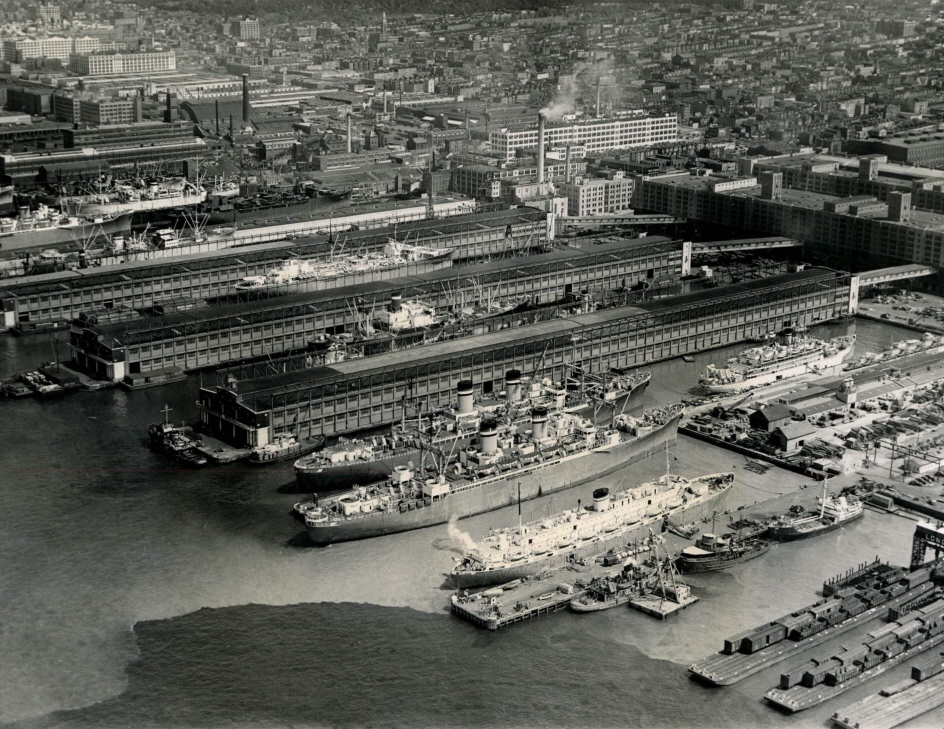
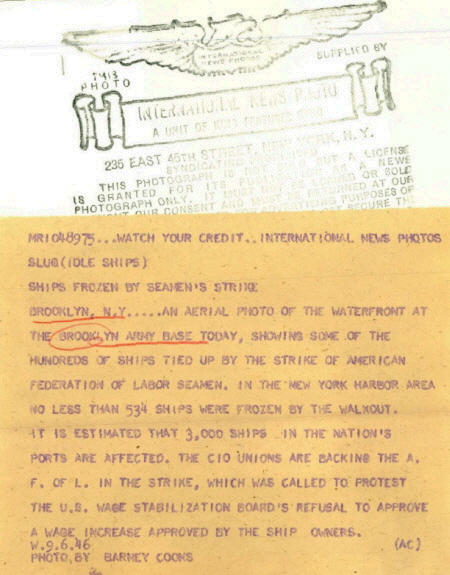
September 6, 1946
International News photo
courtesy of J. DeMay
added 29 June 2010
.
.
Repatriation of Fallen Soldiers of WWII
.
One of the more somber and poignant tasks
the Brooklyn Army Terminal has been used for, was it being the point of arrival
of the remains of 5200 fallen servicemen from the European Theater of Operations
after World War II.
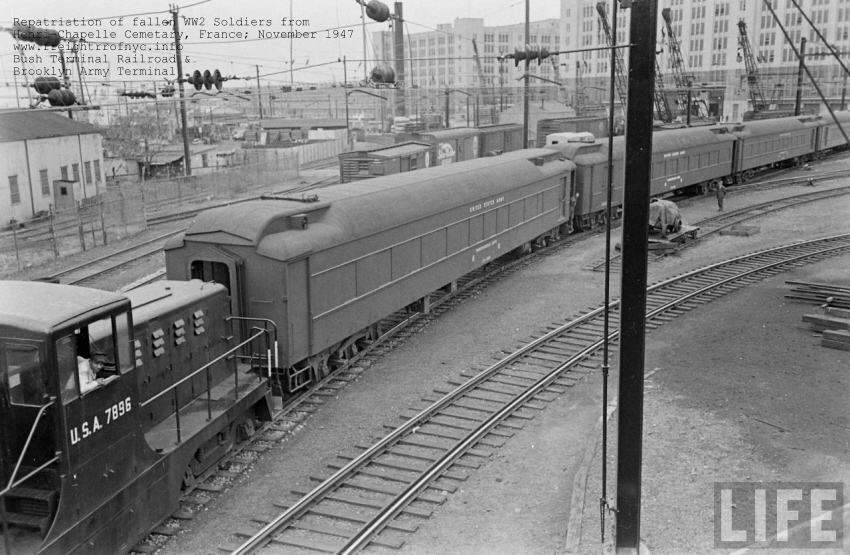
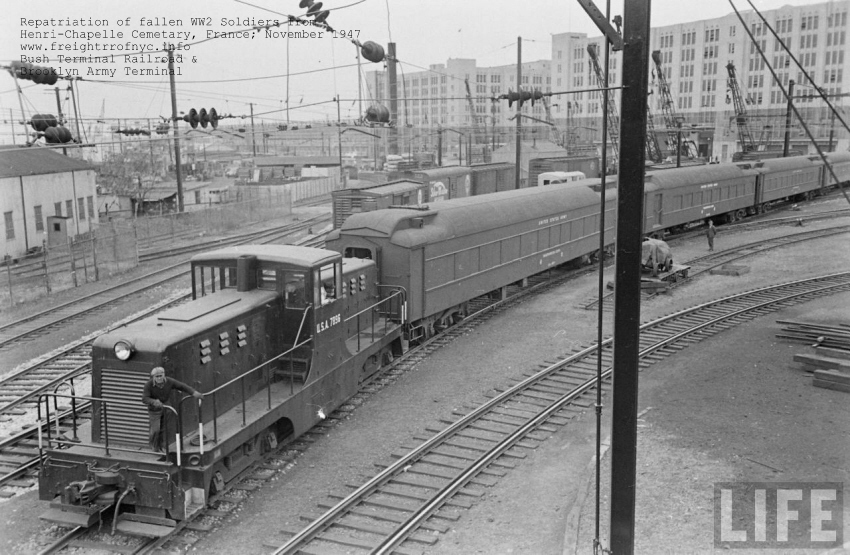
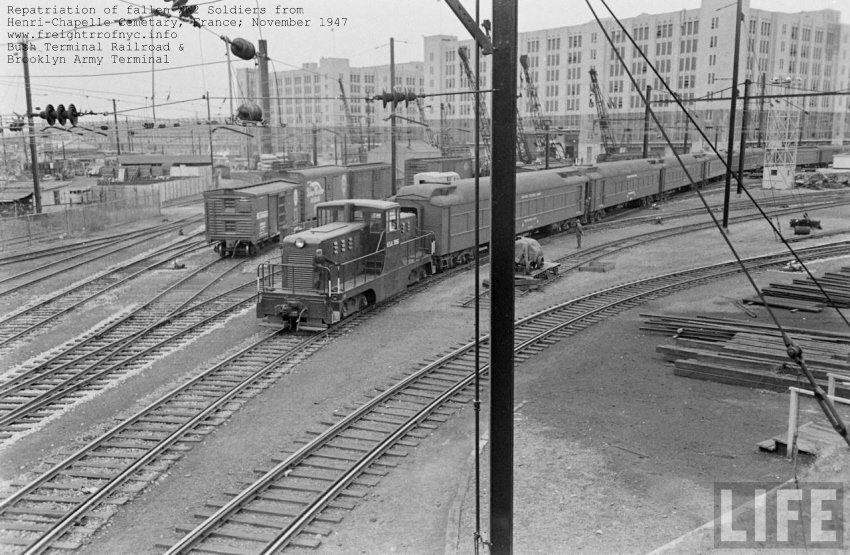
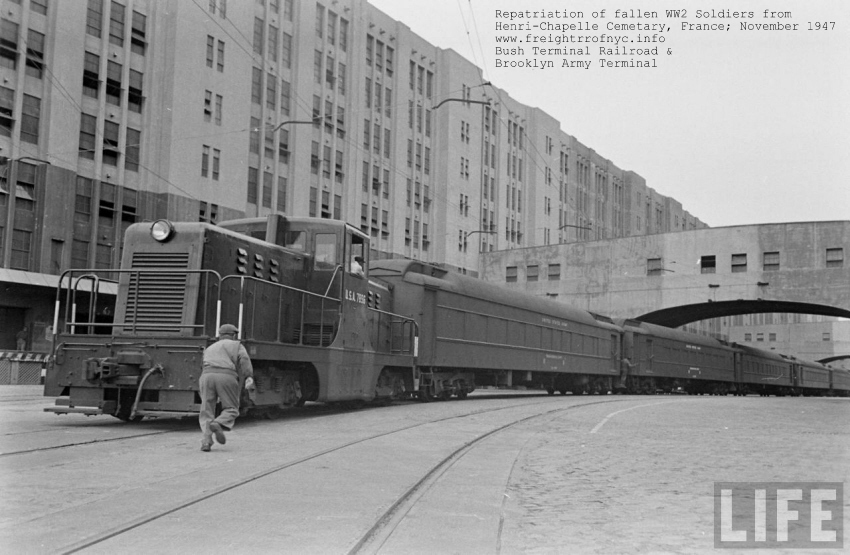
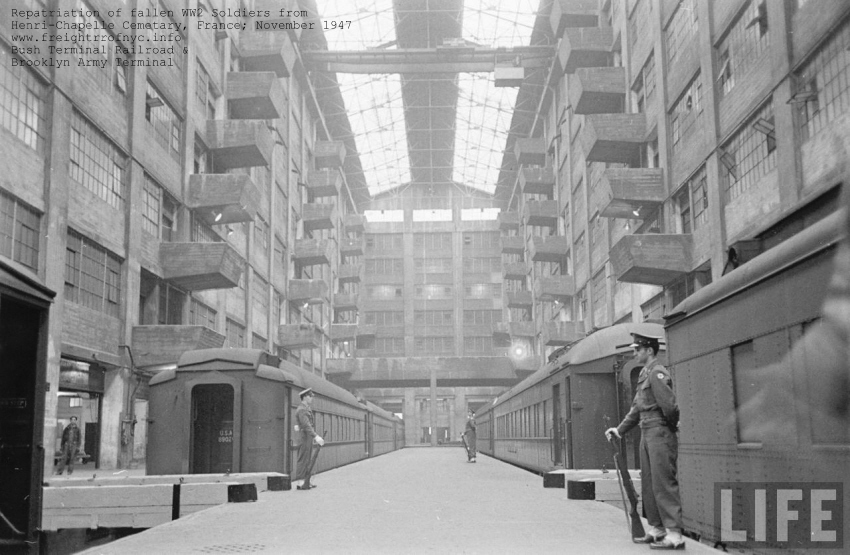
In November 1947, these soldiers were disintered from a cemetery in Belgium and were repatriated to the United States. The ship carrying the caskets docked at the Brooklyn Army Terminal, and the caskets transferred to US Army Transportation Corps Mortuary Cars. Following the completion of loading, the cars were brought from the Army Terminal to Bush Terminal float bridges by a Bush Terminal locomotive and crew. Then, they were placed onboard Bush Terminal Carfloats #44 and 41 and were floated west to Greenville, NJ.
Clicking on the following image will bring you to the collection of images once seen in an issue of Life Magazine. A link at the bottom of that page or the back arrow on your browser will return you here:
.
.
Fortunately, almost all of the Brooklyn Army Terminal structures still exists to this day; but the piers have been torn down. The buildings have since been converted to civilian & commercial applications, including an annex to a local hospital.
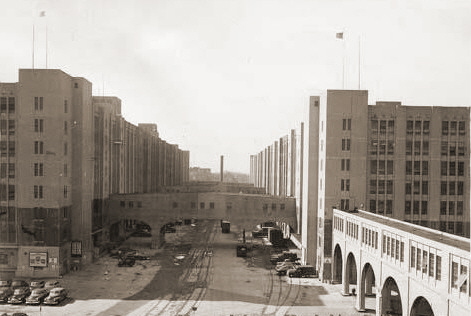
The following image is looking south along First Avenue from the main gate. Crossing First Avenue are the skybridges from Building 'B' (on the left) to Building 'A' (on the right). The arched bridge on the right side of the photo led from Building 'A' to the Administration Building.
Those tracks in the foreground lead to Bush Terminal. The New York New Haven & Hartford / Long Island Railroad 65th Street Yard (out of view) is past the Army Terminal buildings in the background:
.
.
.
Trackage & Rail Service
.
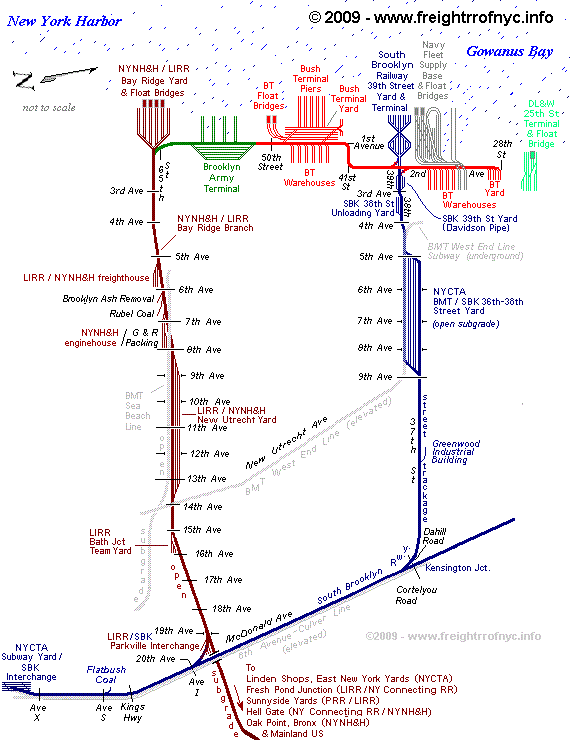
The following schematic, shows the Brooklyn Army Terminal trackage (in green) in relationship to the other railways in the area: Bush Terminal (in red) and the New York, New Haven & Hartford / Long Island Rail Road Bay Ridge Division (in brown) and via the Bush Terminal, the South Brooklyn Railway (in blue).
Please keep in the mind the schematic is not to scale, and is a composite representation of all the railways and industries in the area throughout the twentieth century, although not all industries may have operated at the same time as others.
.
.
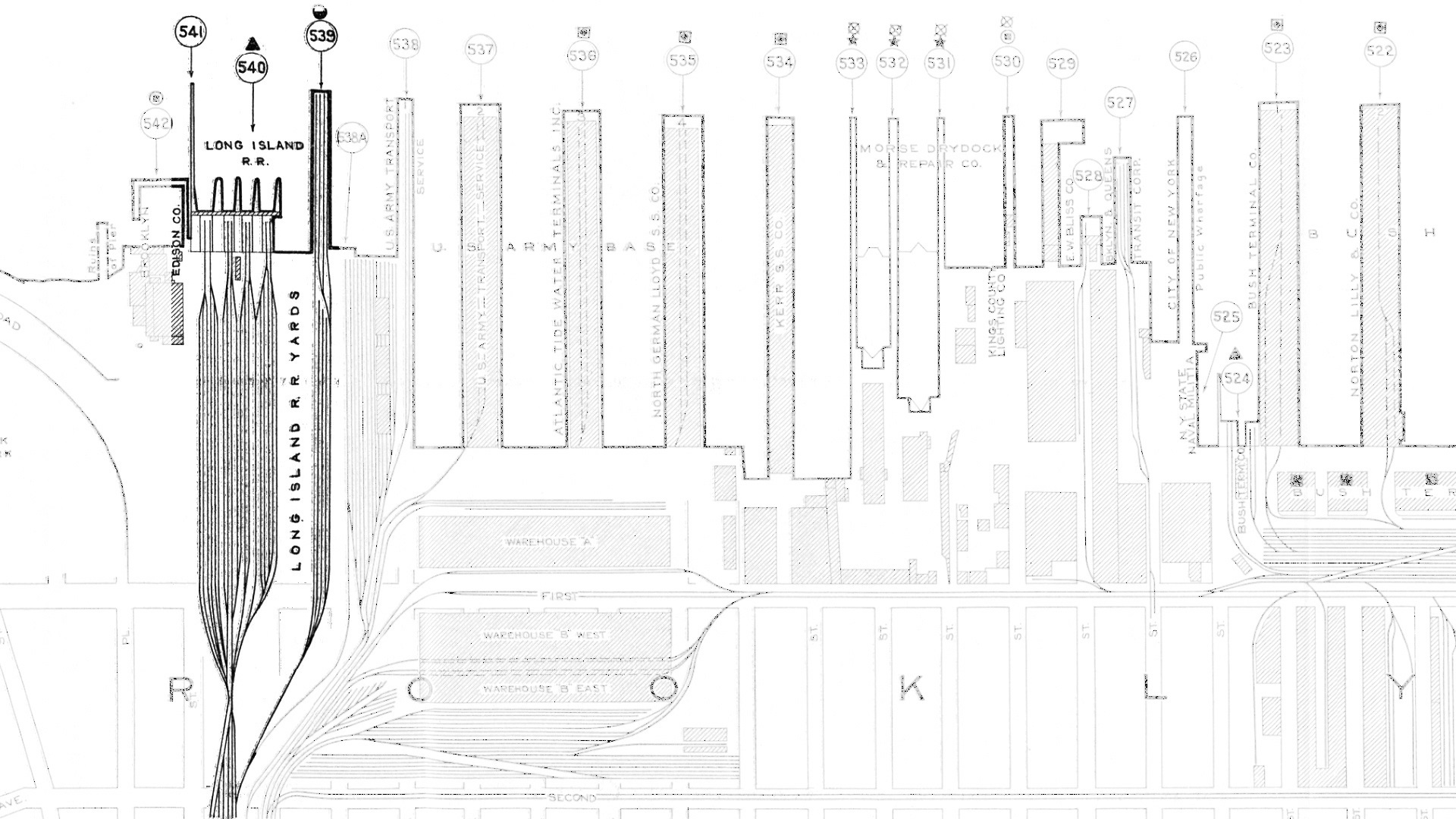
The Brooklyn Army Terminal utilized a track layout of modest proportions with a aggregate amount of trackage totalling 17 miles, and could house over 1,250 cars of 40' length and by referencing the map below, we can discern that the Brooklyn Army Terminal property actually contained nine railyards.
The Brooklyn Army Terminal trackage could be accessed by locomotives on the Bay Ridge Division of the New York New Haven & Hartford / Long Island Railroad's Bay Bridge Branch at the southeastern corner of it's property, and by the Bush Terminal Railroad at the north end of the property.
The following image shows the extensive trackage layout at the Brooklyn Army Terminal and the adjacent Long Island Rail Road /New York & New Haven Railroad 65th Street Yard:
Historic American Engineering Record (HAER) #NY202
Library of Congress Digital Archives
The original providence of the map is given as Engineering News Record
1919.
BAT property annotated by author
..
.
Port Facilities at Port of New York - 1932 edition
Upper Bay - Brooklyn, Map 54
Corps of Engineers, US Army
original courtesy of University of Missouri-St. Louis Digital Archives
added 25 April 2019
.
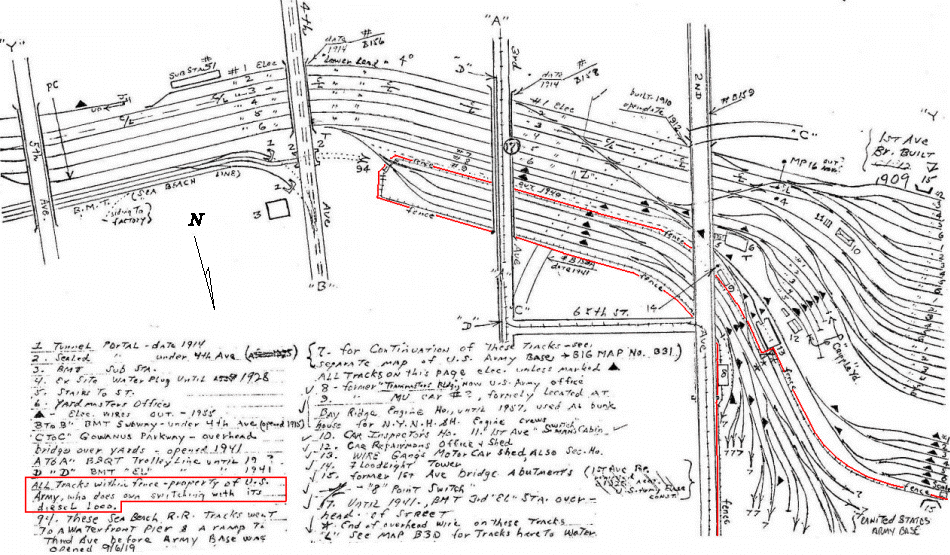
This map, coming to light in December 2009 and part of a series of Long Island Rail Road track maps drawn by Robert Emery. I happened to be referencing the Bay Ridge Branch maps in my research on some of the industrial customers along that route, when I happened across the notation:
"All tracks within fence - property of U.S. Army, who does own switching with its diesel loco."
The map is shown below, and I have highlighted the notation and the fenced area. The significance of notation will be discussed in the locomotive chaprter following this one.
R. Emery map
courtesy of S. Lynch
added 16 Dec 09
.
.
What makes the Brooklyn Army Terminal unique in terms of railroad operations, is that one of the buildings constructed at the Brooklyn Army Terminal, "Building B"; incorporated two indoor tracks with platforms 740 feet long for a total capacity of 50 cars. This structure was also equipped with three overhead cranes with a clear height of 101 feet.
The entire interior of this loading dock and trackage was covered by a glass skylight, which permitted operations in the daytime without the need for artificial light and in all types of weather. This indoor loading / unloading area also provided security for "sensitive" or secret matériel.
The staggered platforms (balconies) seen on the left and right sides of the following two photos allowed for cranes to pick up or deliver items from various levels without interference from the floor above. Moveable bridges which spanned the individual tracks could be relocted anywhere needed, which provided greater loading & unloading flexbility. One these bridge can be seen immediately infront of the box car on the right track under the word "Public" in the watermark.
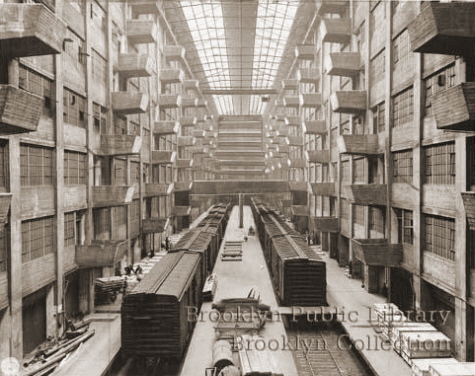
Brooklyn Army Terminal - January 10, 1945
"These freight cars are being unloaded in 'the well' of one of the
huge Army Transportation Corps warehouses
at the Brooklyn Army Base Terminal [located on Second Avenue from 58th Street
to 65th Street],
an installation of the New York Port of Embarkation."
US Army Signal Corp photo
Brooklyn Public Library archives
.
.
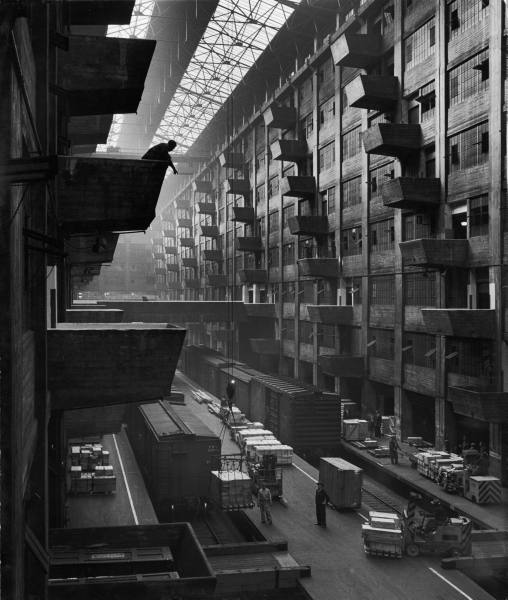
Brooklyn Army Terminal - October 1949
"Off-loaded freight from box cars being hoisted up to jutting loading
platforms at Brooklyn Army Base."
Andreas Feininger photo
Life Magazine archives
added 21 Dec 2008
.
.
Some research for this chapter by Paul Strubeck, reflects that the majority of car movements within the BAT were administered to by the motive power of the Long Island Rail Road, but little information and no photos have surfaced in regard to these Long Island Rail Road movements.
Beginning in 1941, locomotive builders records reflect several entries for locomotives acquired for specific use at the Brooklyn Army Terminal. As far as can be ascertained, the BAT would employ the use of their own dedcated locomotives through the late 1950's possibly ealry 1960's, howevera an exact date on which BAT gave up their own locomotive operations current eludes us.
According to Joe Roborecky, when New York Dock assumed operations of Bush Terminal in 1972, New York Dock leased trackage rights within the Brooklyn Army Terminal from the City of New York of whom by this date owned the Brooklyn Army Terminal property.
Inside of Building B, two Long Island Rail Road P72 passenger cars are landlocked within, which are covered in detail in a chapter below.
.
.
The builders records of the Plymouth Locomotive Works, show a 3 1/2 ton Model HL - Type 2 36" gauge locomotive, construction number 3213, built 5/17/29; being sent to the BAT from Raritan Arsenal, NJ. This locomotive is not marked for export either. Until this locomotives usage at the BAT can be proved or disproved, I have listed it for reference.
As all trackage as constructed and in place within the BAT is of standard gauge width, it is left to ponder why a narrow gauge loco was sent to the BAT, unless there was a narrow gauge trolley system set up in one of the warehouses.
As referenced in the chapter above, a revealing notation on Long Island Rail Road track maps drawn by Robert Emery.
"All tracks within fence - property of U.S. Army, who does own switching with its diesel loco"
.
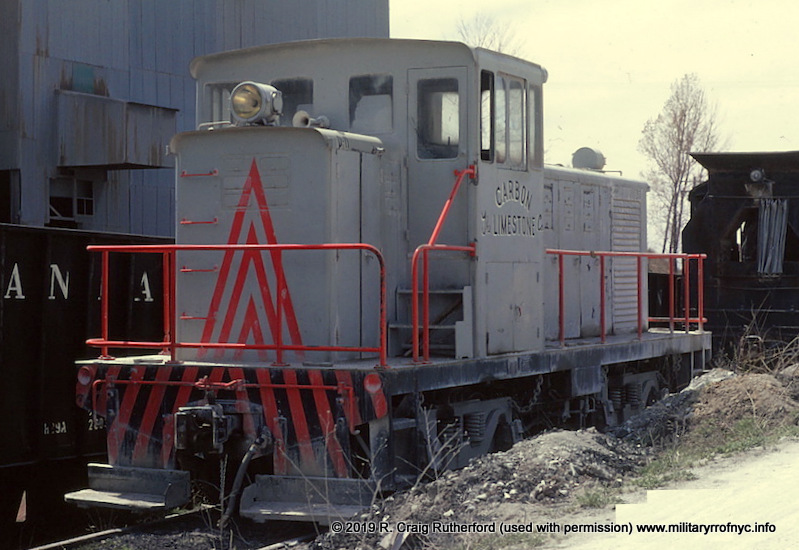
The following image, courtesy of R. Craig (www.thedieselshop.us); is of Carbon Limestone D-11, which was USA Army 7501 assigned to Brooklyn Army Terminal, and identical to four other locomotives assigned there.
.
.
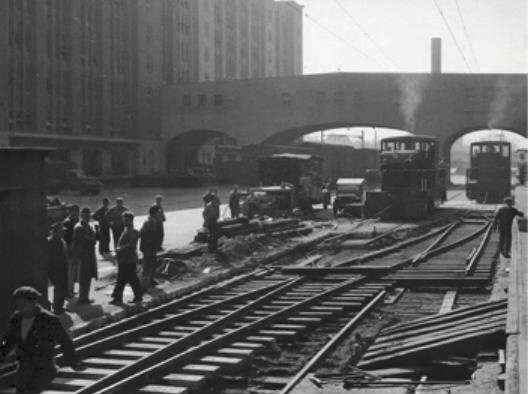
This next image is from the Brooklyn Army Terminal history archives. It is undated and looking north. It shows a General Electric 80 tonner on the left track and a either an Ingersoll-Rand or an GE Off Center Cab (which can be determined by the square shape of the nose and headlight mounted on top of the hood), on the right track. This could be one of the Ingersolls of the Bush Terminal locomotive stable, or one of the Brooklyn Army Terminal GE OCC's.
In any event, all evidence now points to the fact that Brooklyn Army Terminal did indeed have locomotives on premises to switch cars in their railyard.
added 25 Oct 2008
.
.
Lapse forward to 17 June 2011, when Paul Strubeck sends a link pertaining to a series of image taken when 5200 fallen servicemen were repatriated from a cemetery in Belgium to the United Stated. In several of these images, a U. S. Army locomotive is seen shifting the US Army Transportation Corps Mortuary Cars the Brooklyn Army Terminal!
Just as fortunate, it the images clearly show the locomotive and number: A General Electric 80 tonner with U. S. A. 7896 on the cab...
Yet another revelation, seen in the images below; is that the overhead catenary from New York, New Haven & Hartford / Long Island Railroad's 65th Street Yard leads into the Brooklyn Army Terminal and even partially northward up First Avenue (completely within the Brooklyn Army Terminal property). Undoubtedly, this would allow for NYNH&H RR overheead electric powered locomotives to interchange within the Brooklyn Army Terminal.
|
|
| .
. |
|
|
| .
. |
|
|
| .
. |
|
|
Thanks are in order to the research and generosity of John Taubeneck, as he has furnished a roster of both GE locomotives and railway cranes of assorted manufacture that are listed by the Brooklyn Army Terminal.
It is confirmed that locomotive #7864 and #7896 were in fact assigned to and operated at Brooklyn Army Terminal. #7449 may also operated at this location as well. These three locomotives are highlighted in the table below.
Other locomotives listed may have simply been ordered and shipped to and from the Brooklyn Army Terminal for forwarding to their final shipping destination.
.
.
Brooklyn Army Terminal Locomotive Roster
builder.......... |
c/n.......... |
build date |
gauge |
model | wheel arrangement |
wheel dia |
acquired |
number / name |
disposition |
notes |
ref |
| Plymouth | 3213 | 5/17/1929 | 36" | 3½T HL2 | B | new . |
from Raritan Arsenal, NJ | [6][a] | |||
| Plymouth | 3902 | 5/26/1937 | 60" | 8T DLL 2 | B | new . |
War Dept | [6][b] | |||
| Plymouth | 3903 | 5/27/1937 | 60" | 8T DLL 2 | B | new . |
[6][b] | ||||
| Plymouth | 4069 | 11/15/1940.......... | std. | 45T KC | B or B - B? . |
new | USA #7426 | to Camp Claiborne, LA; for sale 2/1946 |
300 hp? | [6][c] | |
| GE | 13142 | 10/14/1941 | std. | 60 Ton off center cab |
B-B | used USA QMC #6042 |
USA #7501, USA CoE Brooklyn Army Base, Bay Ridge, NY . |
Ringwood Iron #7501, Ringwood, NJ; Carbon Limestone #D-11. Bessemer, Pa |
CB ENL-8 120/120-4GE838 D/E 420hp |
||
| GE | 15091 | 1/23/1942 | std. | 60 Ton off center cab.. |
B-B | used USA QMC #6005; USA #7506, 52nd Coast Artillery, Ft. Hancock, NJ; . |
USA #7506, Brooklyn Army Base, Jersey City, NJ |
Ringwood Iron Mine #7506. Ringwood, NH; Carbon Limestone #D-12. Bessemer, Pa |
CB ENL-8 120/120-4GE838 D/E 420hp |
||
| GE | 15092 | 1/23/1942 | std. | 60 Ton off center cab |
B-B | used USA QMC #6004; USA #7505, 52nd Coast Artillery, Ft. Hancock, NJ; . |
USA #7505, Quartermaster Depot, Jeffersonville, IN; Continental Steel #106, Kokomo, Ind |
CB ENL-8 120/120-4GE838 D/E 420hp |
|||
| GE | 15093 | 1/23/1942 | std. | 60 Ton off center cab |
B-B | used USA QMC #6006; US Army #7507, 52nd Coast Artillery, Ft. Hancock, NJ |
US Army #7507, 830th AAF Depot, Memphis, TN; For sale – War Assets Administration 2/1948 American Steel Foundries #9G5 > #5, Alliance, OH; Alliance Castings #5, Alliance, OH; Portage County Fairgrounds, Randolph, OH (Donation – Deal Not Completed); Mahoning Vly RR Hstrc'l Assn, Youngstown, OH - On Display . |
CB ENL-8 120/120-4GE838 D/E 420hp |
|||
| GE | 17891 | 7/16/1943 | std. | 65 Ton center cab |
B-B | new? | USA #7177, Brooklyn Army Air Base, Jersey City, N J |
US Dept of Corrections #7177, Lorton, VA “Lorton & Occoquan
RR”... Birmingham Rail & Loco (Dlr), Birmingham, AL; Florida Steel, Tennessee Steel Div, Jackson, TN Birmingham Steel Corp #YD-02, Seattle, WA Nucor Steel #YD-02, Seattle, WA .. |
HBIS-600 130/130-4HM838 D/E 400hp (2) |
||
| GE | 17910 | 6/21/1943 | std. | 80 Ton center cab |
B-B | 38” | new | USA #7449, Brooklyn Army Base, Brooklyn, NY |
US Dept of Energy, Mississippi
Test Site, Lamar County, MS; River Terminal Development #6, Kearney, NJ . |
LI-600
(2) D/E 500 hp 160/160-4HM833 |
|
| GE | 18014 | 8/3/1943 | std. | 80 Ton center cab |
B-B | 38" | new | US A #7864, Brooklyn Army Base, Brooklyn, NY |
Bush Terminal #88, Brooklyn,
NY New York Dock #88, Brooklyn, NY Naparano Iron & Metal, Newark, NJ (scrapped @ Bush Terminal) .......... |
LI-600
(2) D/E 500 hp 160/160-4HM833 |
|
| GE | 18061 |
11/6/1943 |
std. |
80 Ton center cab |
B-B | 38" | new | USA #7896 Brooklyn Army Base, Brooklyn, NY |
Erman Corp, Turner, KS North Carolina State Port Authority #L-5, Wilmington, NC |
LI-600
(2) D/E 500 hp 160/160-4HM833 US Army order #281-3105- Model IIA2 (Reed) . |
|
| GE | 31349 | 7/18/1952 | std. | 80 Ton center cab |
B-B | 38" | new | US Army #1642, Brooklyn Army Base, Staten Island, NY |
New Cumberland General Depot, New Cumberland, PA - for - US Army #1642, Brooklyn Army Base, Staten Island, NY US Navy #65-00502, Naval Supply Depot, Bayonne, NJ US Army #1642, Ellwood Ordnance Plant, Ellwood, IL US Army #1642, Iowa Ammunition Plant, Middletown, IA US Army #1642, Red River Army Depot, New Boiston, TX . |
NHBIS D/E 400hp Cummins (2) 160/160-4GE747 |
Locomotive Footnotes
| [a] | Fate - Root - Heath / Plymouth Locomotive sales records indicate this locomotive was ordered by the Raritan Arsenal, Metuchen, NJ, and shipped to the Brooklyn Army Base, Brooklyn, NY. |
| [b] | Fate - Root - Heath / Plymouth Locomotive sales records indicate these two locomotives were ordered by the War Department, Washington, DC ansd shipped to the New York Port of Embarkation, Bay Ridge Station, Brooklyn, NY. These locomotives may have been for export to an overseas military facility. |
| [c] | Fate - Root - Heath / Plymouth Locomotive sales records indicate this locomotive was ordered by the War Department, QMCUSA, Washington DC, and shipped to Port Quartermaster, U.S. Army, Brooklyn, NY; Renumbered 7426, Camp Claiborne, LA; for sale via WAA (War Assets Administration) 2/1946 |
.
.
John Taubeneck also furnnished railway cranes that were shipped to the Brooklyn Army Terminal. In two of the Life Magazine images above, seven of the cranes can be seen in the background behind the train, with their booms in upright position.
By no means should it be considered this roster complete, as this list is only from one (Ohio Locomotive Crane) of many equipment manufacturers.
.
Brooklyn Army Terminal Railway Crane Roster
builder |
c/n |
build date |
gauge |
model | wheel arrangement |
liftuing capacity |
boom length |
power |
acquired |
disposition |
notes |
ref |
| Ohio Loco | 4219 | 11/25/1942 | std. | G | B-B | 35 tons | 50' | gasoline | new | New York Port of Embarkation | [56] | |
| Ohio Loco | 4273 | 4/29/1943 | std. | G | B-B | 35 tons | 50' | gasoline | new | New York Port of Embarkation | ||
| Ohio Loco | 4445 | 11/16/1944 | std. | G | B-B | 35 tons | 50' | gasoline | new | Royal Dutch Blast Furnace & Steel Works; Ymuiden, Holland, 1949 |
New York Port of Embarkation | |
| Ohio Loco | 4446 | 11/29/1944 | std. | G | B-B | 35 tons | 50' | gasoline | new | Chantiers Equipment; Paris, France 1949 Societe des Grands Travaux de Marseille; Paris, France 1949 |
New York Port of Embarkation | |
| Ohio Loco | 4447 | 11/30/1944 | std. | G | B-B | 35 tons | 50' | gasoline | new | Chantiers Equipment; Paris, France 1949 | New York Port of Embarkation | |
| Ohio Loco | 4448 | 11/30/1944 | std. | G | B-B | 35 tons | 50' | gasoline | new | Chantiers Equipment; Paris, France 1949 | New York Port of Embarkation | |
| Ohio Loco | 4449 | 12/01/1944 | std. | G | B-B | 35 tons | 50' | gasoline | new | Royal Dutch Blast Furnace & Steel Works; Ymuiden, Holland, 1949 |
New York Port of Embarkation | |
| Ohio Loco | 4450 | 12/06/1944 | std. | G | B-B | 35 tons | 50' | gasoline | new | Establissments H. Michelot; Paris, France 1949 | New York Port of Embarkation |
.
Long Island Rail Road BG72B (MP72) Bar - Generator Cars in Building B & the Elvis Connection (not)
.
Inside of Building B, are two Pullman Standard passenger cars from the Long Island Rail Road. P72's were built by Pullman Standard from May 1955 to March 1956.
Urban legend has it they were used for an Elvis Presley movie.
They were NOT. These cars were not placed in Building B until 1985. For
those of you who need a refresher in your history, Elvis Presley passed
in August 16, 1977.
As discussed in the Port of Embarkation chapter above and
reiterated here in further detail, we do know for fact that
Elvis shipped out on September 22, 1958 from
the Brooklyn Army Terminal upon deployment in Germany with the Third
Armored Division. Images of a set of documents auctioned off
by Graceland Auctions (Lot 30, January 7, 2016 Auction) describe
the details of his arrival by train and debarkation:
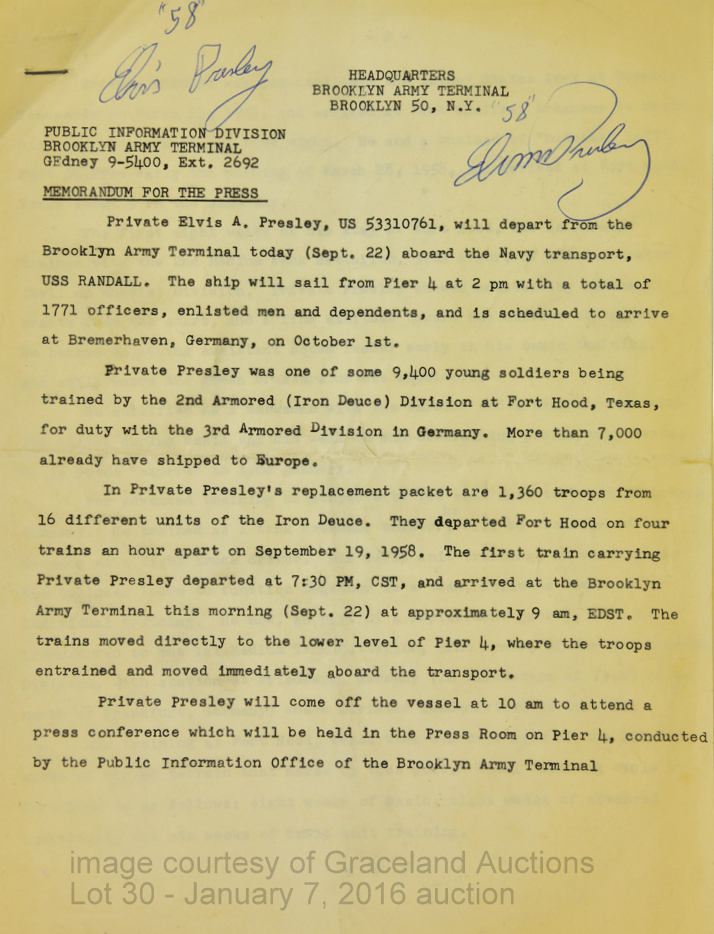
So, we know the train carrying Mr. Presley pulled directly into
the ground level of Pier 4, at which the troops detrained and boarded the USS General Randall (troop transport with the
designation P 115) at 09:00.
Then, Mr. Presley disembarked from the ship at 10:00;
holding a 40 minute press conference was held in the press
room of Pier 4. On conclusion of that, he reboarded the U. S. S. General Randall, and the ship sailed at 14:00.
Other accounts of the day also state he did not enter Building B and
the Long Island Rail Road train carrying him and other soldiers
discharged directly onto the pier.
However, it is known that the
vessel General Randall had been used in 1956 in the war film "Away All Boats".
So, personally, I think it is the convolution of two seperate events
that have lent themselves to the urban myth the cars were used in an
Elvis movie..
Returning to those two passenger cars in Building B; both are bar
/ generator cars. I asked Benjamin Schaeffer, and he was able to shed some light on the matter. One of
the two in Building B is definitely LIRR 2104, as the numbers can be
seen beneath the coats of paint; as witnessed and recorded personally by himself. As the Long Island Rail Road only had four
numbered bar/generator cars numbered 2101, 2102, 2103 and 2104
make their history fairly easy. So, I referenced Steve Lynch's website on the Long Island Rail Road, and was able to ascertain the following information from several different pages, which I collated and consolidated from those entries to here.
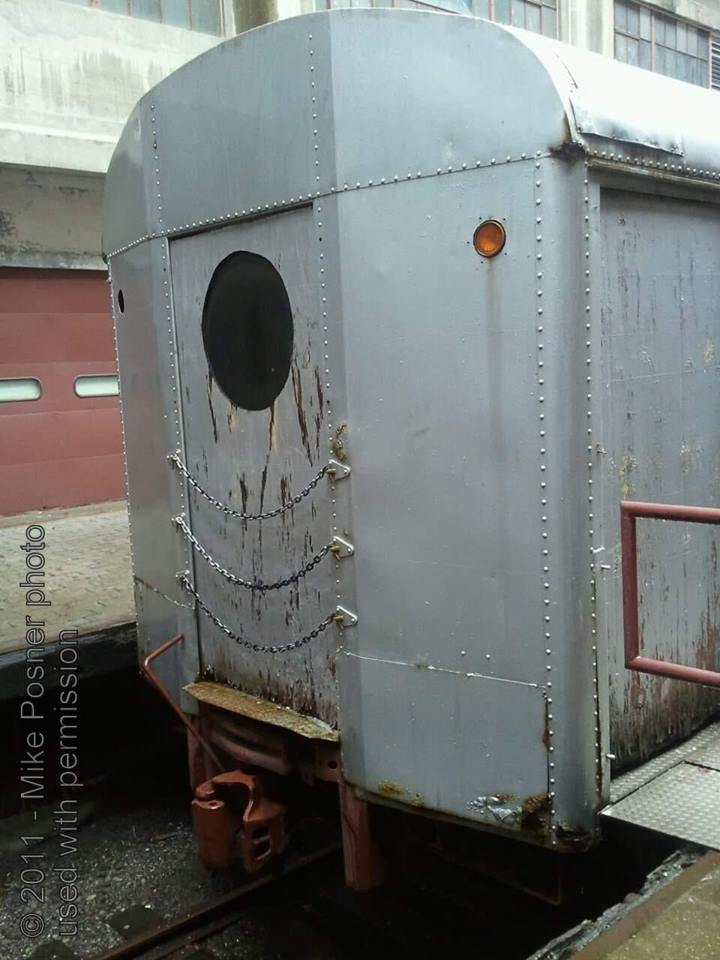
The four cars #2101 through #2104 were converted in 1976 from MP72T's. LIRR #2601, #2608, #2610 and #2648 converted to bar / generator cars, class BG72B, during push-pull conversion, for supplying heating, lighting and air conditioning to push-pull cars in the absence of a power unit. All seating and window shades removed and diesel generator compartment and bar installed on one side of car. Windows by generator compartment replaced with air filters and grills. Traction motors, third rail shoes and shoe beams removed; automatic air hose couplers replaced with standard hoses; one toilet installed. Also on that site was this info Jack Deasy:
Bar Generator cars, Class BG72B in the 2101-2104 series, which had a large diesel generator installed inside a large compartment in the carbody, with a bar in the other end of the car located mid-train. These cars had large vents in one side of the car body. These were rebuilt from MP72T coaches while the railroad was converting to push-pull operations.
The primary purpose of these 4 cars was to provide HEP (600 VDC) via trainline to push-pull equipped coaches in trains that did not have a cab control powerpack unit or an MP-15AC to provide HEP.
Each Bar / Generator cars was equipped with two gensets. The
engines were Detroit 8V71's rated at 318hp equivalent to 237 KW
electric power output. So, each bar / generator car could supply 474 KW of power for
the HEP trainline.
It is understood the bar / generator cars did not stay in service long as the added weight of the generator sets and the constant rocking of the train made the floors sag, as well as cause the outer wall of the cars to eventually start to bulge out. They had to be taken out of service for safety reasons and all are believed to have been retired by 1979.
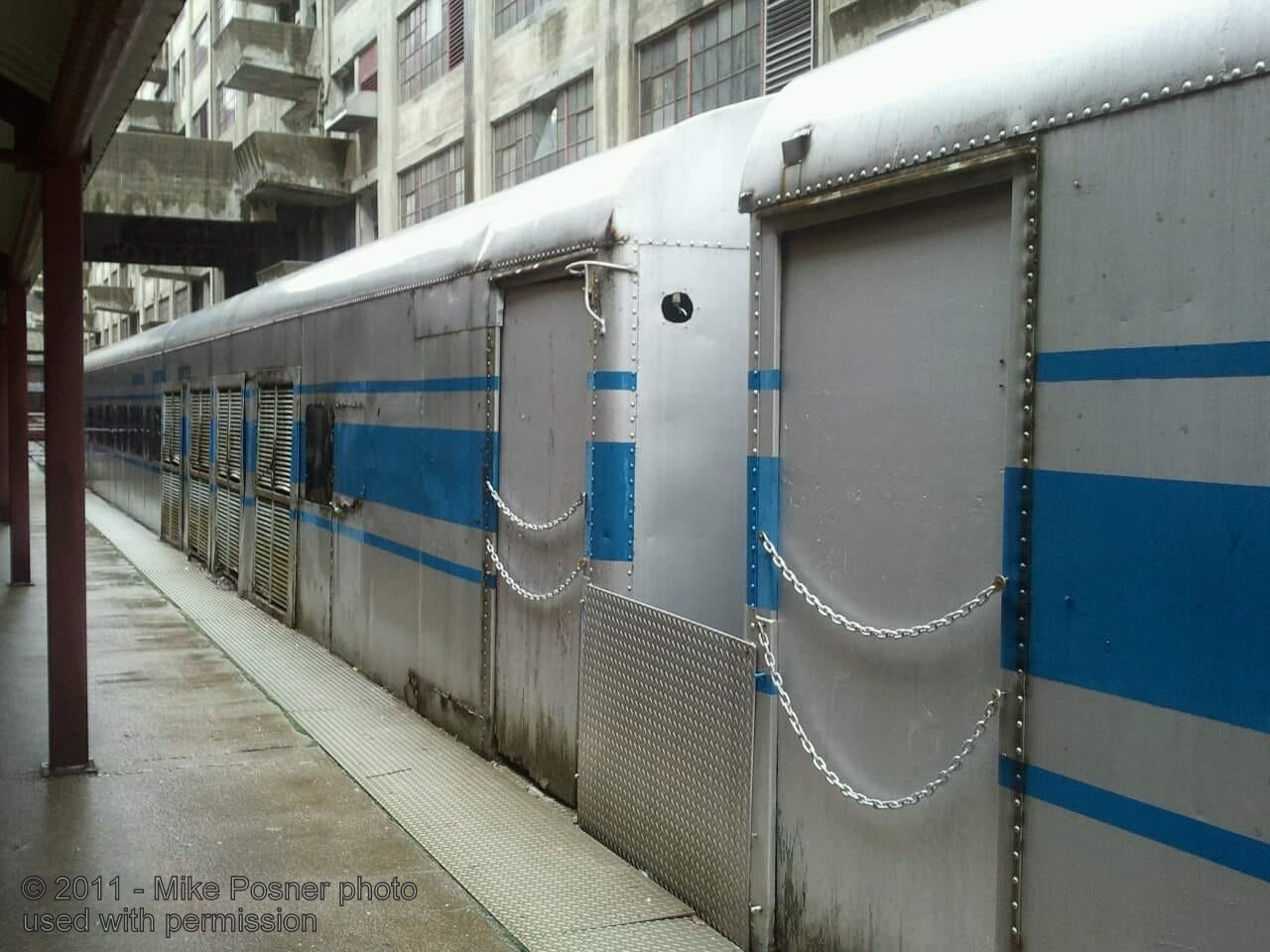
Originally as built and delivered they were painted in dark gray. During the MTA era they were repainted Platinum Mist with Blue window band and were in such livery when they were converted in 1976.
Ben also recalled that Robert Diamond (of Brooklyn Historic Railway Association / Atlantic Avenue Tunnel fame) had been involved with the cars at some point and contacted him on his own accord. Bob had the following information to offer.
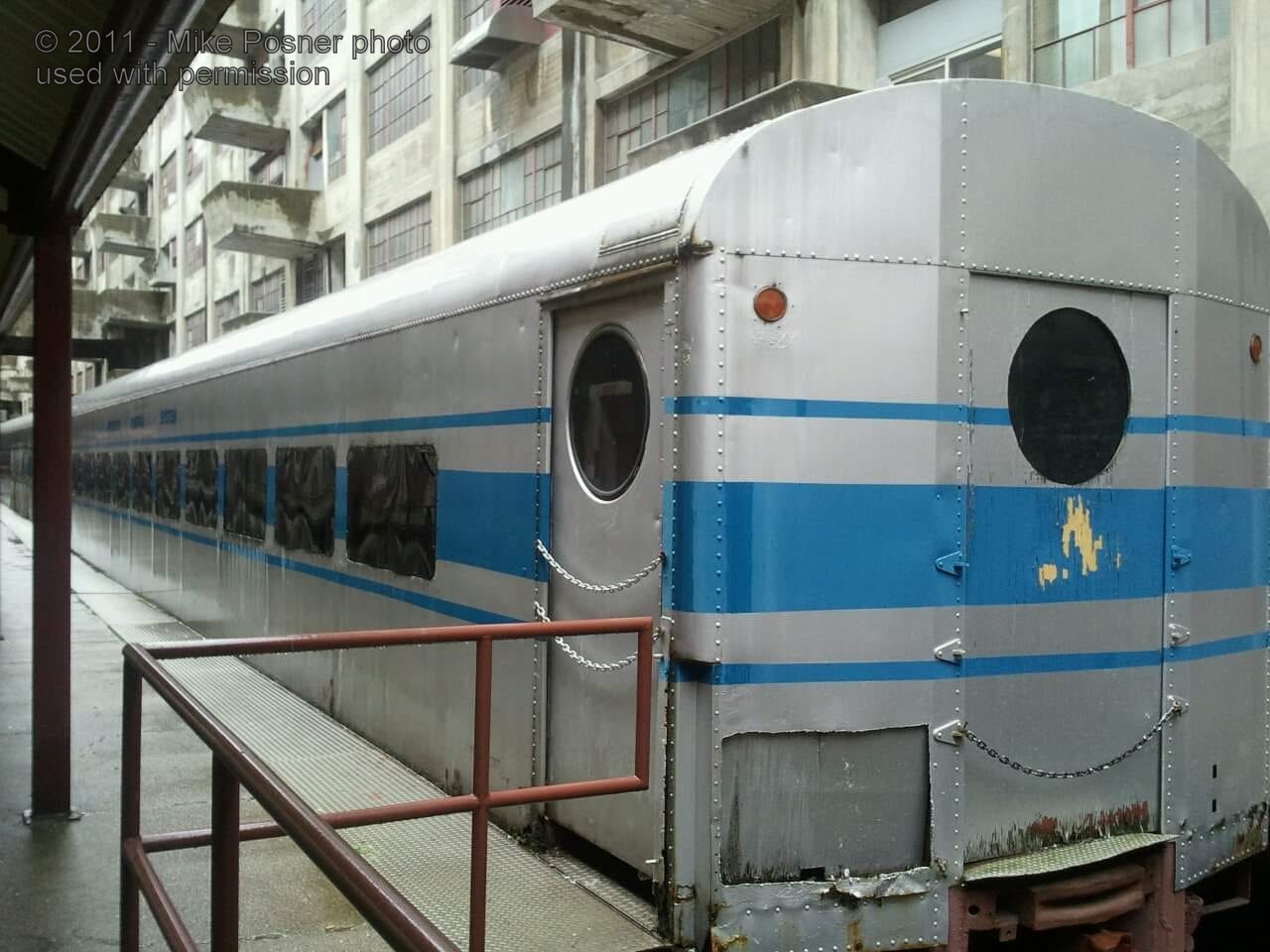
There were plans between an individual (name not remembered, and not Mr. Diamond himself) and Ray Aufiero of the New York Cross Harbor Railroad to organize a dinner train that would operate along the Bay Ridge Branch utilizing these cars and New York Cross Harbor motive power. For as yet unknown reasons, that plan fell through. The cars were then put in Building B in 1985 by the New York City Economic Development Corporation. There was talk that they were to be used as a cafe / restaurant. Bob was contracted to paint the blue & silver scheme and "Brooklyn Central Lines" as seen in the following circa 2011 Mike Posner images below.
That plan failed to materialize as well. One of the two generator
units from one of the cars was acquired by Bob to use to power his
equipment stored at New York Cross Harbor. Then there was a plan to
make these cars walk through historical
displays pertaining to the Brooklyn Army Terminal. Another use stated
was as office type accomodations for the
contractor(s) hired to renovate some the Brooklyn Army Terminal
buildings. Being they had their own power, made them
self-sufficient.
Bob also mentioned that they had consecutive numbers. As
2104 is a confirmed number by Ben, that would make the other 2103.
 |
....... |
|
|
|
||
.
.What ever their intended use was for, came to naught and they were abandoned in situ. Then the access doors on the building face was bricked over, so they are truly captive within Building B. Any ideas or rumors of removing them will require either tearing out the brick wall or cutting them up in place and removing them in pieces.
They have also since been painted brown with gold lettering "Brooklyn Army Terminal".
In February 2021, I recevied an email from Bill Mangahas offering the following image for inclusion here. It is of one of the bar cars before re-painting: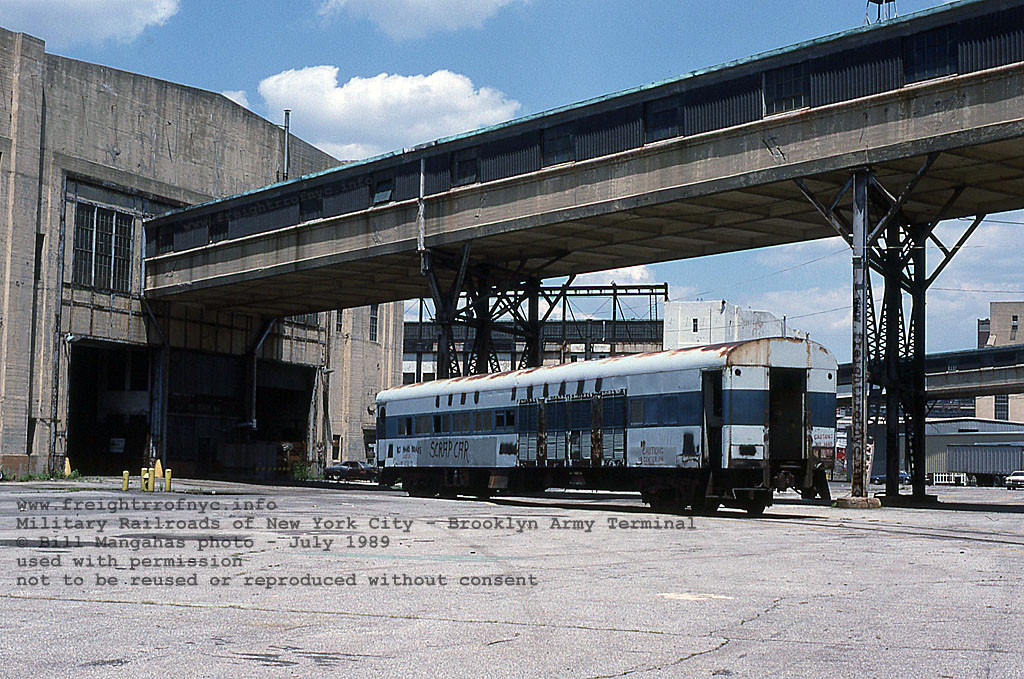
Naturally, anyone else with detailed information and / or images on these cars are more than welcome to submit them here:
Index:
|
Military
Railroads of the New York Metropolitan AreA |
||||
| Earle N.A.D. N.W.S. Earle |
||||
| Fort Totten | Fort Terry | Fort Hancock / Sandy Hook Proving Grounds | ||
| . Sign The Guestbook |
||||
.